
What do quantum physics and resilience building have in common?


“The discovery of quantum theory, I believe, is the discovery that the properties of any entity are nothing other than the way in which that entity influences others. It exists only through its interactions. Quantum theory is the theory of how things influence each other. And this is the best description of nature that we have.”
— Carlo Rovelli
Last week I took a dip in my local reservoir - it’s a bit nippy now, so it certainly wakes you up - and on my cycle home I listened to my new favourite podcast, Radical by Amol Rajan. He was interviewing one of his heroes, Carlo Rovelli, a theoretical physicist and world-renowned thinker.
When asked what he considered the most revelatory insight of quantum physics, Rovelli said it was the discovery that nothing can be defined in isolation from the things around it - that there is no such thing as a single, separate entity. He writes:
“The world is not a collection of things. It is a network of events, and the relations between these events are what we call reality.”
I don’t pretend to know much about physics. But suddenly, perhaps magnified by my post cold-water euphoria, I felt I could relate to some of the theory of physics - because it echoed concepts I think about all the time.
I’ve spoken before about Dan Siegel’s work, the relationship neuroscientist whose concept of MWe (powerful concept, less strong name) explores the impossibility of separating “me” from “we.” We literally cannot develop as human beings without relationships. The notion of a completely separate self is an illusion - we are deeply interconnected and interdependent. For children in particular, this isn’t a nice-to-have: it is a biological necessity.
As Rovelli puts it beautifully in Helgoland (2022):
“Relational quantum mechanics tells us that we are not separate islands. We are knots in a web of relationships.”
MWe is Siegel’s shorthand for an integrated identity that holds both Me (individuality, agency, differentiation) and We (connection, belonging, mutuality) together. At the core of his work is a message about resisting the idea that we must choose between independence (“me”) and merging (“we”). Both are essential - and both can coexist.
Siegel places MWe within the broader framework of interpersonal neurobiology, which sees the mind as embodied, relational, and emergent - regulating energy and information flow in part through our connections with others.
“... the roots of security and resilience are to be found in the sense of being understood by and having the sense of existing in the heart and mind of a loving, caring, attuned and self-possessed other — an other with a mind and heart of her own.” - Dan Siegel
He argues that cultivating MWe is crucial because it:
Builds resilience & well-being. Connection (we) buffers and supports us; autonomy (me) gives us agency and direction. Together they create strength.
Fosters belonging without loss of self. MWe allows us to feel part of something larger while staying fully ourselves.
Strengthens relationships and communities. When we integrate me + we, relationships are healthier and communities more cohesive.
Expands our identity and ethics. Seeing ourselves as part of a wider whole can shift how we respond to global challenges like division, inequality, and climate change.
Encourages ongoing integration. Practices like Siegel’s Wheel of Awareness help us stay mindful of both individuality and connection.
Both Siegel and Rovelli are scientists - working in different contexts - and yet they are drawing similar, almost ancient, conclusions: that we are deeply interconnected.
This week I also read a Substack post about the extraordinary strength of sequoia trees, written by Rob Avis, an engineer-turned-permaculture designer:
“Most people think sequoias survive because they’re massive. But that’s not even close to the real reason.
... The tallest tree in the world has roots that only go 6–12 feet deep. That should be impossible. A 300-foot tree with shallow roots makes no sense from an engineering perspective.
But… sequoias don’t survive alone. Their root systems spread 50–80 feet wide and interweave with every other sequoia around them. They share nutrients, water, and structural support. When storms come in, they support each other.
The forest is the system — not the individual trees.
... The most resilient systems in nature are interconnected.”
The trees share resources, and this makes them resilient - able to do things that seem impossible.
Sometimes the notion of the essential nature of interconnectedness can be quite depressing - especially when loneliness statistics look so stark; the pressure of knowing the benefits of a strong relational network but not being in a position to have one for yourself or your family. The pandemic was a huge interrupter of people’s connection networks and the support they brought. It was a very difficult time for me personally.
On the other hand, there is great relief in remembering that we were never designed to do this life thing alone. As someone who always believed that strength came from independence, it’s totally changed my life to understand that strength comes from connection with others.
And what if we are more connected than we think?
I tried an exercise: I drew concentric circles on a piece of paper and plotted the people I’d had meaningful interactions with over the past seven days. In the centre were my two kids, Kit and Coco, and our cat Prince (who my children insist is a fully fledged family member). In the next circle: those I’d had close contact with and had seen in person - my friends I’d been to the theatre with or on a walk or talked on the phone with, my boss Mike, even my ex (who had given some useful advice on my soon-to-be new flat).
Then I worked outward: former Nike colleagues I’d spoken with on Zoom who had offered coaching insights; parents who helped with school runs; my brother, mum, and aunt; my parent coach; my listening partner; my business coaching leader and cohort; and my coaching clients. Further out still were the tradespeople helping with the flat, neighbours, friends sharing work opportunities, my accountant, and the Cub leader who hosted a weekend camp-out with my kids.
By the end, I counted around 45 people I had connected with in some meaningful way over the past seven days - from sharing tasks and services, to offering and receiving emotional support, to simply enjoying each other’s company.
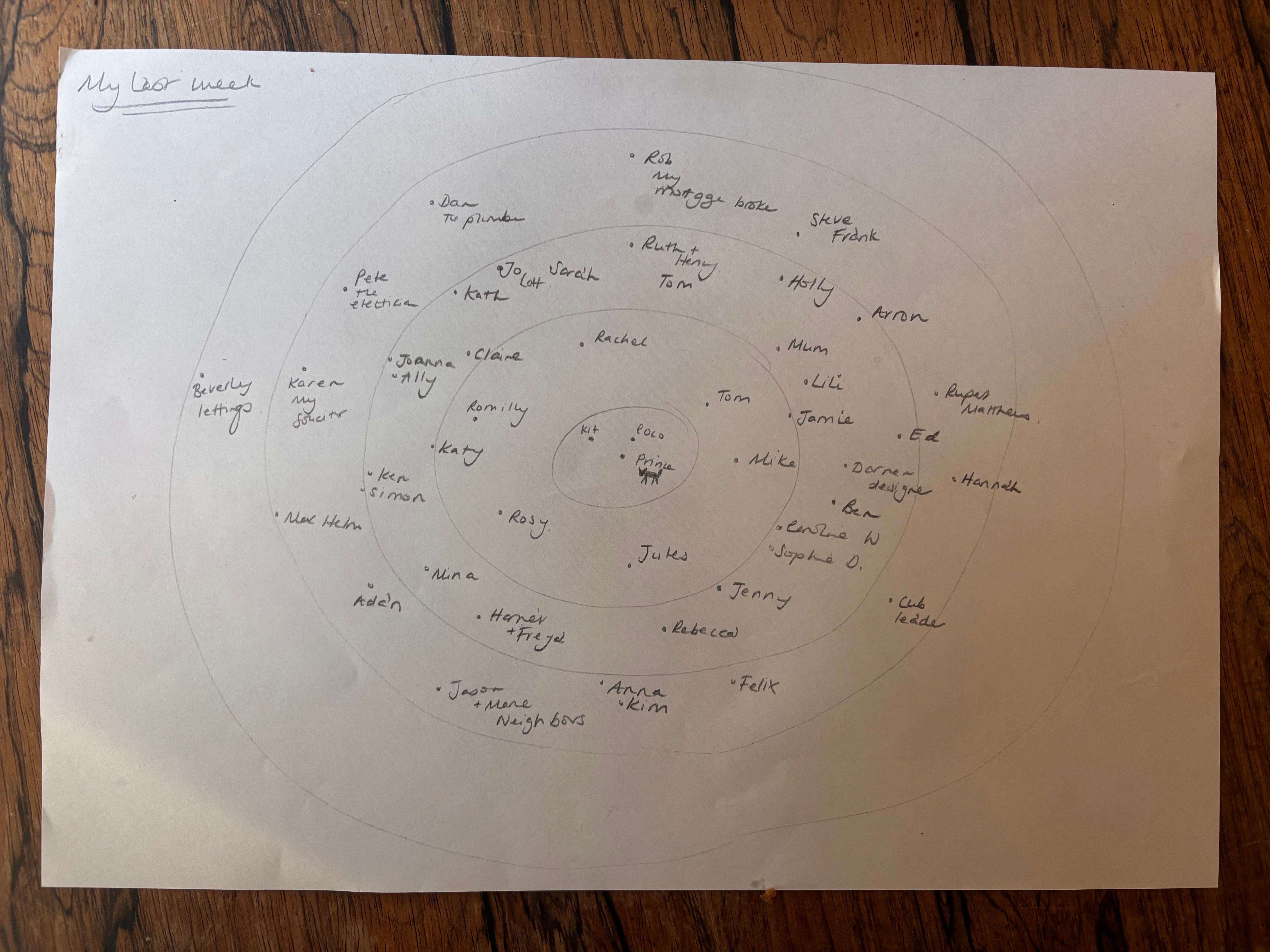
If you’d asked me before I did this task, I might well have said I felt disconnected - working from home as a single parent can feel isolating. But the evidence was clear: my life is profoundly intertwined with others. It was a surprisingly powerful exercise and one that really made me appreciate just how many and how often. I also realised that for the majority of those relationships, they feel healthy and mutual. I could also see clearly the 1 or 2 where they weren’t relationships I would choose to have, but maintain out of necessity.
Building a strong network
This brings me to one of my favourite books this year that I’ve written about before: Your Invisible Network by Michael Melcher. He argues that building and tending your network - bit by bit - is one of the greatest forms of wealth you can create. His 20-minute daily practice helps strengthen these ties, and his final chapter offers 100 practical ideas.
“Relationships are a form of wealth … you can build this wealth from nothing, and once you have it, no one can take it away from you.” - Michael Melcher
One of my favourite practices he suggests is the art of the ping: send a message to someone just because you thought of them. No ask, no expectation - simply the gift of holding someone in mind. (As Siegel would say, that’s a core building block of emotional connection.)
Here are a few other 20-minute daily exercises for building a richer network across work, personal, and home life that I liked:
Next time you’re in a boring place (an airport, school pick-up line), send a bunch of friendly texts to “weak ties” - not just the usual suspects.
Craft your version of a “no response required” message: “Hey, I was thinking of you” or “Read this article and thought you might like it.” Do this several times a week.
Spend time on LinkedIn looking up people from past jobs and see what they’re up to. If they’re doing something new, send a note of congratulations.
Stock up on birthday cards. Keep a stack ready and send them out as birthdays approach.
Send a “you can do it!” message to someone working on something hard — finishing a manuscript, training for a marathon.
Make a list of your “A people” - those who give you energy. Put your top three on a Post-it note and keep it on your desk.
Write a job description for a potential mentor - clarity helps you spot them when they appear.
Ask a friend or colleague if they have sponsors or mentors, and how those relationships formed.
Write a thank-you note for something you never properly acknowledged: “Many months (or years) ago you helped me by ____. I didn’t thank you at the time, but it meant a lot.”
Initiate a group text or email to a set of friends you like but rarely see. Suggest a date and place to meet.
What I love about Melcher’s work is that it’s not just about professional networking - he knows our lives are far more interconnected than that. Some of my dearest friends are former colleagues, and some of my oldest friends from childhood have worked with me in advertising and beyond. Also, many of his ideas also work for those of us who can’t be out at London soirées every night.
One of the greatest gifts of the modern world, if used well, is that we can connect with others in ways that fit our busy, often remote lives. And how critical this is for our well-being.
As Carlo Rovelli reminds us:
“All things are continually interacting with each other, and in doing so each bears the traces of that with which it has interacted: and in this sense all things continuously exchange information about each other.”
I love this thought. We all bear the traces of each other, continuously exchanging ourselves with others.
So here’s an invitation: try your own version of the concentric circles exercise.
Take a piece of large paper
Draw 6 concentric circles
Start in the middle with your core relationships
Work outwards with decreasing levels of intimacy
Now notice how much of your life is made possible by those relationships - seen and unseen.
Or send one “ping” today: a short message to someone you haven’t spoken to in a while, just to say they’re in your thoughts.
These small acts are how we strengthen the web we all live in. And they’re how we make the world a little more connected - and ourselves a little more resilient.

I’m Abi, an executive coach & advisor working with leaders in the brand & marketing industries to lead themselves and others with greater self-agency. If you’d like to know more about my work, visit adessa.io or drop me a line at abi@adessa.io